

War in the Middle East has – again – shown how vulnerable Europeans are to volatile global oil and gas prices, and none more so than those with the least cash to spare. Renewable local power offers a way out, yet too many of those who struggle to pay their bills fear that Europe’s clean energy transition is unaffordable, unfair and out of reach.
Today, however, from Poland to Porto, people and communities are overcoming serious social and economic disadvantages and engaging in programmes that show how we can all benefit from healthier homes and cleaner, happier neighbourhoods; they’re working together to cut energy waste and switch to low-carbon heating and cooling.
Ten projects from seven countries, selected by expert-guided panels drawn from disadvantaged communities, will now have the chance to grow further and to share what they have learned. That’s thanks to the Escalator programme launched by FETA – Fair Energy Transition for All – an initiative led by the King Baudouin Foundation in partnership with the Schneider Electric Foundation. Since 2020, FETA has been listening to people from Europe’s most disadvantaged communities to design strategies and policies for an affordable clean energy future that improves lives for everyone.
To spread and develop robust practices, in this new phase of its work FETA will work with these 10 community-led teams to scale up their activities, connect them to each other and to a wider community of knowledge and expertise, and aim to replicate their successful models more widely around the continent. With the European Union driving to decarbonise housing in order to meet its climate goals, more than one in 10 EU citizens cannot afford to heat their homes. FETA’s goal is to ensure the climate transition brings people together, that it helps heal, not deepen, Europe’s social divides.
The selected projects target low-income households and differing social groups, including young people, the elderly, disabled people, migrants, and women and gender minorities in a variety of settings, from inner city Brussels to rural villages on Crete. Their actions range from installing solar panels and wind turbines, to sharing energy-saving tips, from training for the jobs required for eco-transformation to insulating homes. But what they all have in common is that vulnerable and disadvantaged people are at the heart of every decision and empowered to collaborate on solutions that work for them.
Too often, the move to clean energy is framed as a costly inconvenience that creates fear and opposition among those Europeans least able to afford additional demands on their limited resources; FETA has already demonstrated that, offered full information and a chance to help design solutions that truly work for them, people on low incomes can become enthusiastic drivers of Europe’s ecological transition.
With the launch of the Escalator programme, coordinated by GENIO, we are funding the expansion of highly promising existing projects and also creating a continent-wide network that will exchange knowledge and insights, while inspiring communities, local and national leaders, industry, and civil society groups to learn from proven successes in cutting carbon emissions, costs, and household energy wastage through smart investments.
Our work is powered by a trusted network of operational partners—GENIO, ifok, Energy Cities, Eurocities, and the Social Platform—bringing diverse expertise and reach.
For more information about the selection by disadvantaged communities : Report Focus Groups
2 June 2025
A new phase of FETA started in 2025
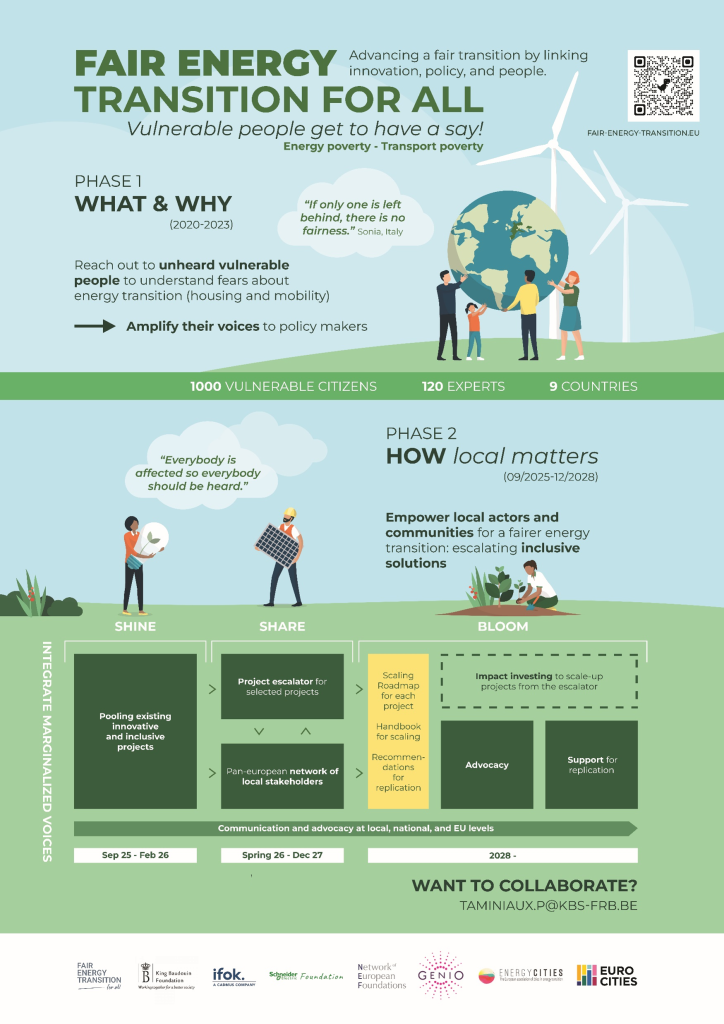
From 2020–2023, FETA gathered insights from 1,000+ vulnerable citizens across the EU on how to make climate and energy policies more inclusive.
We’re excited to announce that now, in Phase 2, we’re moving from listening to action — finding and making visible local solutions across the EU, supporting cities and communities to turn those ideas into sustainable success stories and facilitating EU wide mutual learning.
Why It Matters
Across Europe, too many people are struggling with the rising cost of energy and mobility. In 2023, over 10% of Europeans couldn’t afford to keep their homes warm. Others are being priced out of basic transport. As the EU pushes forward on climate action, there’s a growing risk: that vulnerable citizens will be left behind — undermining both social cohesion and the energy transition itself. We must make the green transition work for everyone.
Our Approach
- Scaling What Works: Up to 10 local projects will be selected through a participatory process including vulnerable citizens’ assessment. These projects will be supported through a “project escalator” — a tailored programme focusing on three objectives: to help them grow (“scaling up”), connect (“mutual learning”), and influence change (“replication”).
- Build a Pan-European Network: We’ll bring together 80+ local stakeholders — city officials, NGOs, social services, civil society — to share knowledge, visit pilot projects, and inspire the application of inclusive housing and mobility solutions.
- Keep Vulnerable Citizens at the Heart: Insights from vulnerable citizens will guide every step. We’ll help policymakers and practitioners build their capacity to include these voices in both planning and implementation.
Project Timeline
Autumn 2025 – Open call for flagship projects
2026–2027 – Project escalator & stakeholder network
2028 – Launch replication call & FETA Handbook for Scaling and Replication
Who’s Involved?
- King Baudouin Foundation (coordination, advocacy)
- Schneider Electric Foundation (strategic and funding partner)
- ifok (methodology, network, communication)
- Genio (scaling support, inclusion)
- Energy Cities (innovation & escalator management)
- Eurocities (policy & local connections)
- NEF (financial management)
- Local country partners (outreach & logistics)
Why Partner With Us?
Join us to:
- Champion a fair, inclusive energy transition
- Support local actors across Europe
- Help scale real solutions for housing and mobility equity
- Ensure that no one is left behind
Let’s Talk
Pascale Taminiaux Van Laere
Senior Project Coordinator
King Baudouin Foundation
taminiaux.p@kbs-frb.be
📞 +32 2 549 02 91