Our Mission
Power to the People
War in the Middle East has – again – shown how vulnerable Europeans are to volatile global oil and gas prices, and none more so than those with the least cash to spare. Renewable local power offers a way out, yet too many of those who struggle to pay their bills fear that Europe’s clean energy transition is unaffordable, unfair and out of reach.
Today, however, from Poland to Porto, people and communities are overcoming serious social and economic disadvantages and engaging in programmes that show how we can all benefit from healthier homes and cleaner, happier neighbourhoods; they’re working together to cut energy waste and switch to low-carbon heating and cooling.
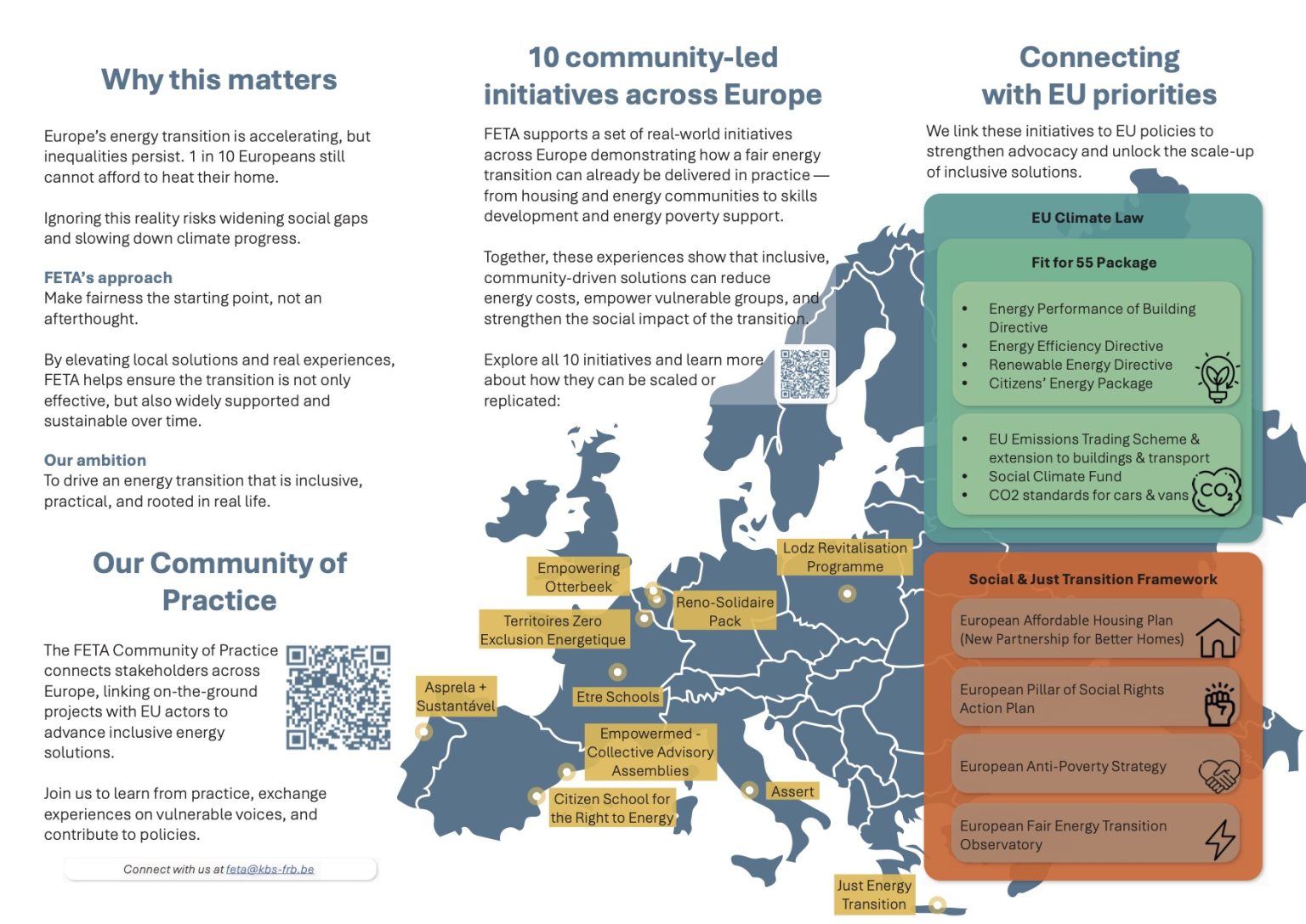
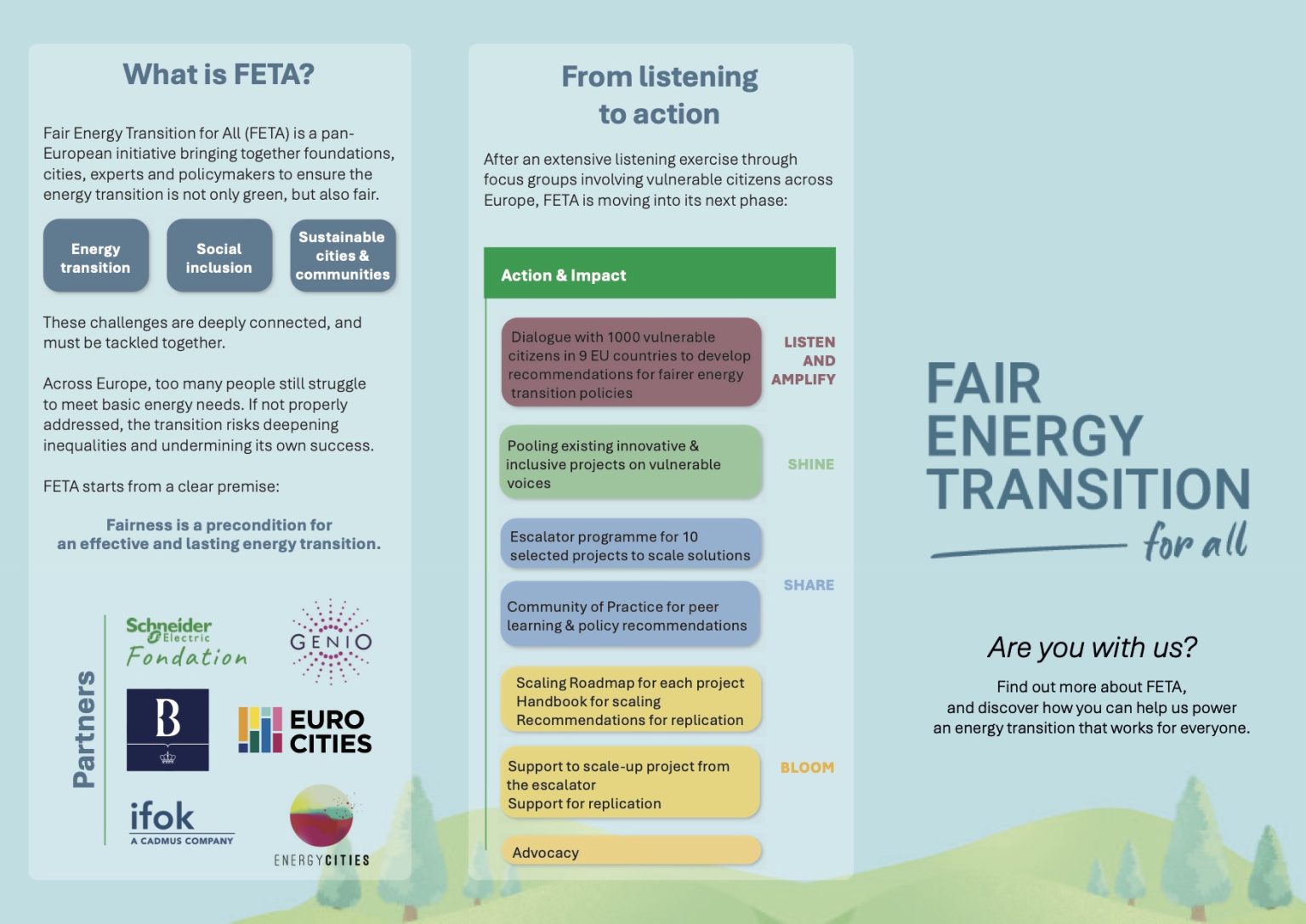
Ten projects from seven countries, selected by expert-guided panels drawn from disadvantaged communities, will now have the chance to grow further and to share what they have learned. That’s thanks to the Escalator programme launched by FETA – Fair Energy Transition for All – an initiative led by the King Baudouin Foundation in partnership with the Schneider Electric Foundation. Since 2020, FETA has been listening to people from Europe’s most disadvantaged communities to design strategies and policies for an affordable clean energy future that improves lives for everyone.
To spread and develop robust practices, in this new phase of its work FETA will work with these 10 community-led teams to scale up their activities, connect them to each other and to a wider community of knowledge and expertise, and aim to replicate their successful models more widely around the continent. With the European Union driving to decarbonise housing in order to meet its climate goals, more than one in 10 EU citizens cannot afford to heat their homes. FETA’s goal is to ensure the climate transition brings people together, that it helps heal, not deepen, Europe’s social divides.
The selected projects target low-income households and differing social groups, including young people, the elderly, disabled people, migrants, and women and gender minorities in a variety of settings, from inner city Brussels to rural villages on Crete. Their actions range from installing solar panels and wind turbines, to sharing energy-saving tips, from training for the jobs required for eco-transformation to insulating homes. But what they all have in common is that vulnerable and disadvantaged people are at the heart of every decision and empowered to collaborate on solutions that work for them.
Too often, the move to clean energy is framed as a costly inconvenience that creates fear and opposition among those Europeans least able to afford additional demands on their limited resources; FETA has already demonstrated that, offered full information and a chance to help design solutions that truly work for them, people on low incomes can become enthusiastic drivers of Europe’s ecological transition.
With the launch of the Escalator programme, coordinated by GENIO, we are funding the expansion of highly promising existing projects and also creating a continent-wide network that will exchange knowledge and insights, while inspiring communities, local and national leaders, industry, and civil society groups to learn from proven successes in cutting carbon emissions, costs, and household energy wastage through smart investments.
Our work is powered by a trusted network of operational partners—GENIO, ifok, Energy Cities, Eurocities, and the Social Platform—bringing diverse expertise and reach.
For more information about the selection by disadvantaged communities : Report Focus Groups
Key milestones
Our Journey
From citizen voices to scalable solutions
2020-2023
Phase 1: Listening
FETA consulted 1,000+ vulnerable citizens across Europe to understand their needs, barriers and expectations in the energy transition. Generated concrete EU and national-level recommendations.
Sep 2025
Phase 2 launch: Selection
10 community-led initiatives selected through a participatory process involving 53 vulnerable citizens. Phase 2 begins its focus on action, scaling and policy influence.
Apr 2026
Escalator Module 1 — Brussels
First 2-day Escalator session at the King Baudouin Foundation: shared contexts and challenges. Initiatives begin peer learning and capacity building.
Sep 2026
Escalator Module 2 — València
Module on strengthening marginalised voices. First SHARE webinar. Quarterly newsletter distributed to the stakeholder network.
2026–2027
Full Escalator and SHARE programme
6 Escalator modules completed. 6 thematic webinars. Policy briefs produced. Recommendations co-created with the stakeholder network.
Nov 2027
European Scaling Handbook
Publication of the handbook drawing lessons from all 10 initiatives on how to scale inclusive solutions in complex systems.
Early 2028
Final EU event and replication call
EU-level event to showcase results and launch the replication call — offering financial support, impact investing and mentoring to replicate best practices across Europe.